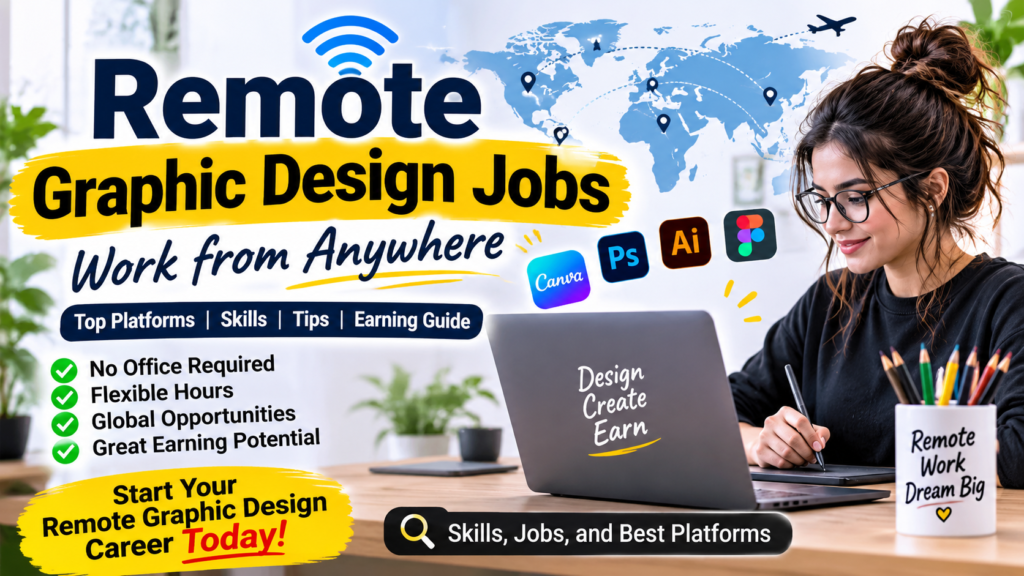

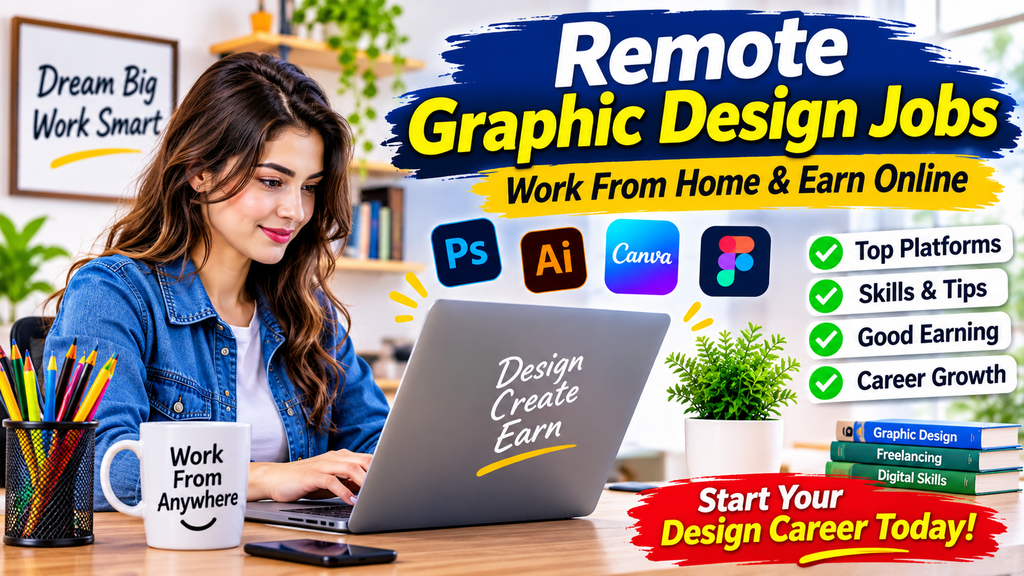
The demand for creative digital content has created opportunities remote graphic design jobs for graphic designers to work with businesses, agencies, startups, and individual clients from different parts of the world. Instead of traveling to a traditional office every day, designers can now complete projects from home, communicate with clients online, and collaborate with international teams through digital platforms.
Remote graphic design jobs are becoming an attractive career option for people who enjoy creativity, visual communication, and digital technology. These opportunities allow professionals to create logos, social media graphics, advertisements, website layouts, marketing materials, and other visual content without being physically present in an office.
Whether you are an experienced designer or someone starting a creative career, remote graphic design jobs remote work can provide different ways to develop your skills and build professional experience. However, finding a suitable position requires more than knowing how to use design software. Employers and clients also look for creativity, communication, reliability, problem-solving abilities, and a strong portfolio.
This guide explains how remote graphic design careers work, which skills employers expect, where to find legitimate opportunities, how much designers can potentially earn, and how beginners can improve their chances of getting hired.
What Are Remote Graphic Design Jobs?
Remote graphic design jobs are professional opportunities that allow graphic designers to complete creative projects outside a traditional office environment. Designers generally use computers, graphic design software, internet connections, and online communication tools to perform their responsibilities.
A remote graphic designer may work for a company as a full-time employee, support an agency through a contract, or provide independent services to several clients.
For example, a small business might hire a remote designer to create a logo and social media templates. An advertising agency may need someone to prepare promotional banners, while an international company could employ a designer to develop consistent visual branding across its digital platforms.
Most responsibilities can be completed online, although certain positions may require occasional meetings, scheduled collaboration, or specific working hours.
How Does Remote Graphic Design Work?
The remote design process usually begins when an employer or client shares project requirements. These requirements explain the purpose of the design, preferred colors, dimensions, target audience, brand guidelines, and expected delivery date remote graphic design jobs.
The designer then researches the project, develops creative concepts, prepares initial designs, and shares them for feedback.
After receiving suggestions, the designer makes necessary revisions and delivers the approved files in the requested formats.
A typical remote workflow includes:
- Receiving project instructions from a client or manager.
- Understanding the target audience and design objectives.
- Creating concepts and visual layouts.
- Preparing designs using suitable software.
- Sharing drafts through online collaboration tools.
- Making revisions based on feedback.
- Delivering final files before the deadline.
This process allows companies to work with creative professionals regardless of their physical location.
Why Are Remote Graphic Design Jobs Popular in 2026?
Remote work has changed how many businesses find and manage creative professionals. Companies can now recruit designers from a wider talent pool instead of limiting their hiring decisions to people who live near an office.
At the same time, businesses need visual content for websites, online stores, advertisements, mobile applications, email campaigns, and social media platforms.
This creates different opportunities for designers with relevant skills.
1. Flexible Working Arrangements
One major advantage of remote graphic design work is flexibility. Depending on the employment agreement, designers may have the freedom to organize their working hours around project deadlines remote graphic design jobs.
Some employers offer fixed schedules, while others allow employees to work asynchronously.
2. Access to International Clients
Remote employment makes it possible to work with companies in different countries. A designer living in Pakistan, for example, may apply for a position with an employer based in the United States, United Kingdom, Canada, or another location.
However, international opportunities do not automatically mean every job is available worldwide. Applicants must check the employer’s country restrictions, work authorization requirements, and time-zone expectations.
3. Reduced Commuting Costs
Working from home eliminates the need for daily travel to an office. Designers can save time and reduce expenses associated with transportation, meals outside the home, and other commuting activities.
4. Different Career Opportunities
Graphic designers can specialize in several areas, including branding, digital advertising, social media content, packaging, illustration, and user interface design.
This variety makes remote design work suitable for people with different creative interests.
5. Opportunities for Professional Growth
Working with different clients and creative teams can expose designers to new industries, design approaches, software, and professional standards.
Over time, these experiences can help them develop specialized skills and pursue more advanced positions.
15+ Types of Remote Graphic Design Jobs
Remote graphic design is not limited to creating logos. Businesses need different types of visual materials, and each category requires specific creative abilities.
Understanding these roles can help job seekers identify opportunities that match their interests and existing skills.
1. Remote Graphic Designer
A general graphic designer creates visual materials for businesses, organizations, and marketing teams.
Typical responsibilities include preparing advertisements, brochures, promotional graphics, presentations, and digital layouts.
This role is suitable for designers who understand fundamental design principles and can work with multiple types of projects.
2. Remote Logo Designer
Logo designers develop visual symbols that represent a company’s identity.
Their responsibilities include researching brands, exploring creative concepts, selecting typography, and preparing different logo variations remote graphic design jobs.
A strong understanding of simplicity, originality, color psychology, and brand recognition is important for this position.
3. Social Media Graphic Designer
Social media designers create visual content for platforms such as Instagram, Facebook, Pinterest, LinkedIn, and other digital channels.
Their work may include:
- Promotional posts.
- Social media advertisements.
- Story graphics.
- Carousel designs.
- Event announcements.
- Branded templates.
This is a useful specialization for designers interested in digital marketing and online communication.
4. Remote Brand Identity Designer
Brand identity designers help companies develop a consistent visual appearance.
They may create logos, color palettes, typography systems, business cards, brand guidelines, and marketing templates.
This position requires creative thinking and an understanding of how visual elements communicate a company’s personality.
5. Web Graphic Designer
Web graphic designers create visual elements used on websites.
Their work may include website banners, icons, illustrations, promotional sections, background graphics, and other digital assets.
Knowledge of layout, responsive design, visual hierarchy, and user experience can be helpful.
6. UI Graphic Designer
User interface designers focus on the appearance and organization of digital interfaces.
They may work on mobile applications, websites, dashboards, and software products.
Common responsibilities include designing buttons, menus, cards, navigation elements, and interface layouts.
Figma is a commonly used tool in this area.
7. Advertising Graphic Designer
Advertising designers create promotional materials that help businesses communicate product benefits and marketing messages.
Examples include display advertisements, campaign graphics, digital banners, promotional posters, and sales materials.
These professionals should understand how to combine images, typography, and persuasive visual communication.
8. Packaging Designer
Packaging designers create the visual appearance of product packaging.
Their work may involve designing labels, boxes, product containers, and printed promotional materials.
Knowledge of dimensions, print specifications, typography, and packaging requirements is particularly useful.
9. Presentation Designer
Presentation designers prepare professional slides for business meetings, remote graphic design jobs educational sessions, conferences, and marketing presentations.
They organize information using charts, icons, typography, illustrations, and consistent layouts remote graphic design jobs.
PowerPoint, Google Slides, and other presentation tools may be required.
10. Illustration Designer
Illustration designers create original visual artwork for websites, books, advertisements, educational materials, and digital products.
They may use vector illustration software, drawing applications, or digital painting tools.
This career is suitable for people who enjoy drawing and developing unique visual concepts.
11. Email Graphic Designer
Email designers prepare visual materials for marketing newsletters and promotional email campaigns.
Their responsibilities may include designing banners, promotional sections, product graphics, and branded email layouts.
Understanding readability and mobile-friendly design is important.
12. E-commerce Graphic Designer
Online stores need product images, promotional banners, category graphics, and advertising materials.
E-commerce graphic designers prepare these assets to help businesses present products professionally remote graphic design jobs.
They may also work on seasonal campaigns, product launches, and sales promotions.
13. Motion Graphic Designer
Motion graphic designers create animated visual content for advertisements, videos, presentations, and digital campaigns.
Their work can include animated logos, text effects, transitions, and promotional videos.
Knowledge of animation software is useful for this specialized career.
14. Print Graphic Designer
Print designers prepare materials such as brochures, flyers, posters, magazines, business cards, and catalogs.
They must understand print dimensions, resolution, color modes, and file preparation remote graphic design jobs.
15. Marketing Graphic Designer
Marketing designers work closely with marketing teams to produce visual materials for advertising campaigns.
They may create landing page graphics, promotional images, social media content, and campaign templates.
16. Freelance Graphic Designer
Freelance graphic designers provide services independently instead of working for one permanent employer.
They can accept projects from different clients, establish their own prices, and manage their schedules according to client agreements.
However, freelancers are also responsible for finding clients, managing payments, and maintaining professional relationships.
Essential Skills Required for Remote Graphic Design Jobs
Employers evaluate more than software knowledge when hiring remote designers. They want professionals who can understand project requirements, communicate clearly, solve visual problems, and deliver quality work consistently.
Developing a combination of technical and professional skills can improve your chances of finding suitable employment.
1. Creativity and Original Thinking
Creativity helps designers develop visual concepts that communicate messages effectively.
A good designer should be able to explore different approaches rather than repeatedly using the same templates.
Understanding the client’s brand and target audience also helps produce relevant designs.
2. Typography
Typography is the art of arranging text to make information readable and visually appealing.
Designers should understand font selection, spacing, alignment, hierarchy, and text readability remote graphic design jobs.
Poor typography can make an otherwise attractive design difficult to understand.
3. Color Theory
Color plays an important role in visual communication.
Graphic designers should understand color combinations, contrast, saturation, and how different colors influence the overall appearance of a design.
Choosing an appropriate color palette can help maintain brand consistency.
4. Layout and Visual Hierarchy
Layout determines how different elements are organized within a design.
Visual hierarchy helps viewers identify the most important information first.
Designers should understand alignment, spacing, balance, contrast, and composition.
5. Communication Skills
Remote designers often communicate through emails, messaging platforms, video calls, and project management applications.
They must be able to ask questions, explain creative decisions, understand feedback, and provide regular progress updates.
6. Time Management
Remote employees often manage several assignments with different deadlines.
Good time management helps designers organize their workload, prioritize important tasks, and deliver projects on schedule.
7. Attention to Detail
Small mistakes involving spelling, alignment, colors, dimensions, or file formats can affect the quality of a design.
Careful reviewing before delivery helps maintain professional standards.
8. Problem-Solving Skills
Designers frequently face challenges involving unclear instructions, limited space, brand restrictions, or changing project requirements.
The ability to identify problems and develop practical creative solutions is valuable.
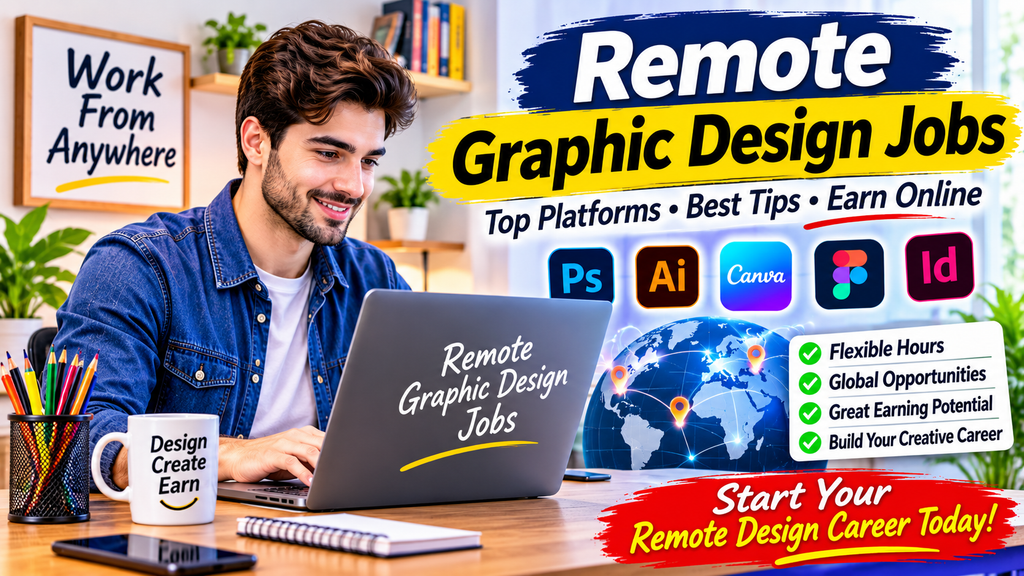
Best Graphic Design Software for Remote Designers
Graphic design software allows professionals to create, edit, organize, and deliver visual content.
The right software depends on the type of work and the employer’s requirements.
Adobe Photoshop
Adobe Photoshop is widely used for photo editing, image manipulation, digital artwork, and promotional graphics.
It is particularly useful for designers who work with photographs and raster-based images.
Adobe Illustrator
Adobe Illustrator is commonly used for vector graphics, logos, icons, illustrations, and scalable artwork.
Vector files can be resized without losing their sharpness, making this software valuable for brand identity projects.
Canva
Canva provides an accessible design environment for creating social media posts, presentations, marketing graphics, and other visual materials.
Its templates and straightforward interface can help beginners develop basic design skills.
Figma
Figma is widely used for interface design, collaborative projects, wireframes, and digital product layouts remote graphic design jobs.
It is especially useful for designers interested in UI and UX-related opportunities.
Adobe InDesign
Adobe InDesign is designed for page layouts and publishing projects.
It is useful for brochures, magazines, catalogs, reports, and other multi-page documents.
After Effects
Adobe After Effects helps designers create motion graphics, visual effects, animated text, and promotional animations remote graphic design jobs.
It is useful for people interested in video-based design services.
Other Helpful Tools
Other applications and platforms can support a remote designer’s workflow:
- Affinity Designer for vector artwork.
- Procreate for digital illustration.
- CorelDRAW for vector and print design.
- Google Drive for file sharing.
- Slack for team communication.
- Trello for task organization.
- Zoom for online meetings.
You do not need to learn every application immediately. Start with the software relevant to your preferred specialization.
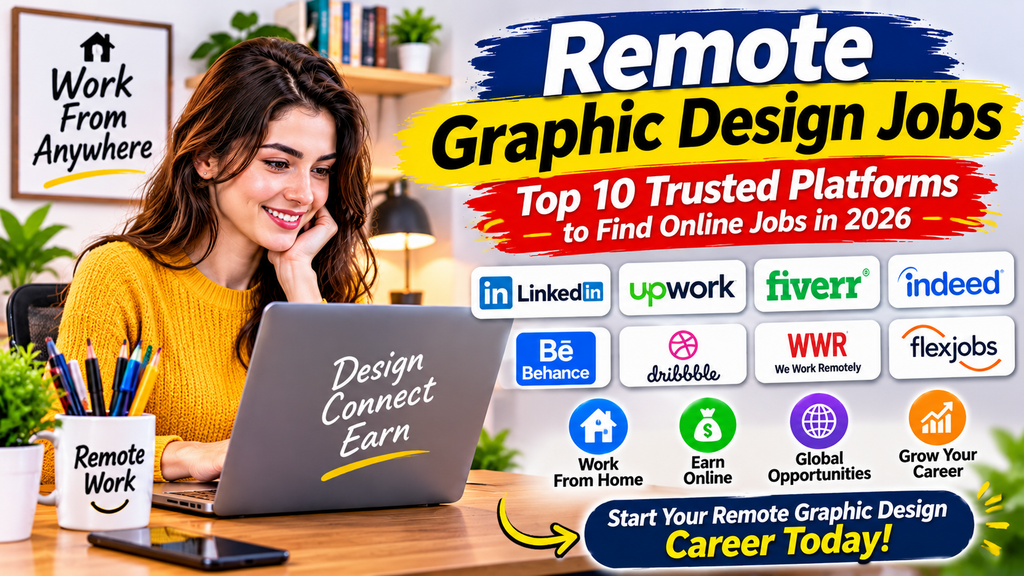
Where to Find Remote Graphic Design Jobs in 2026
Finding legitimate opportunities is one of the most important parts of building a remote design career remote graphic design jobs.
Several online platforms connect designers with employers, agencies, startups, and independent clients. However, each platform has different application requirements and payment arrangements remote graphic design jobs.
1. LinkedIn
LinkedIn is a professional networking platform where companies advertise job openings and connect with potential employees.
Search for terms such as:
- Remote Graphic Designer.
- Work From Home Graphic Designer.
- Remote Visual Designer.
- Junior Graphic Designer Remote.
- Remote Brand Designer.
Use the location and remote-work filters to narrow your search.
You can also follow design agencies, marketing companies, and businesses that regularly recruit creative professionals.
Website: https://www.linkedin.com/jobs/
2. Indeed
Indeed provides job listings across different industries and employment categories.
Candidates can search for remote graphic design positions, upload their resumes, and review employer requirements.
Before applying, carefully check the location restrictions, experience requirements, and employment conditions.
Website: https://www.indeed.com/
3. Upwork
Upwork connects freelancers with clients looking for creative and professional services.
Graphic designers may find projects involving logo creation, social media graphics, brand identity, presentations, and marketing materials.
A complete profile, relevant portfolio samples, and personalized proposals can help freelancers present their abilities.
Website: https://www.upwork.com/
4. Fiverr
Fiverr allows freelancers to create service listings, commonly called gigs.
Designers can offer services such as:
- Professional logo design.
- Social media post design.
- Business card design.
- YouTube thumbnails.
- Brand identity packages.
- Website graphics.
Clear service descriptions, original samples, and realistic delivery expectations can help establish a professional profile.
Website: https://www.fiverr.com/
5. Behance
Behance is a creative portfolio platform where designers can showcase their work and discover professional opportunities.
It is particularly useful for presenting branding projects, illustrations, digital artwork, and complete design case studies.
Website: https://www.behance.net/
6. Dribbble
Dribbble is a design community where creative professionals share their work and discover opportunities.
It can be useful for designers interested in branding, interface design, illustration, and digital product visuals.
Website: https://dribbble.com/
7. We Work Remotely
We Work Remotely publishes remote employment opportunities across different professional categories.
Designers can explore creative positions and review the location or eligibility requirements listed by employers.
Website: https://weworkremotely.com/
8. Remote OK
Remote OK provides remote job listings across multiple industries, including design and creative work.
Applicants should review each listing carefully because some positions are restricted to specific countries or regions.
Website: https://remoteok.com/
9. FlexJobs
FlexJobs focuses on remote, flexible, and other nontraditional employment opportunities.
It can be another source for candidates researching professional remote positions. Check its subscription and access conditions before signing up.
Website: https://www.flexjobs.com/
10. Company Career Pages
Applying directly through company websites is another useful approach.
Digital marketing agencies, software companies, e-commerce businesses, publishing organizations, and design studios may advertise creative positions on their careers pages.
Direct applications can help you discover opportunities that are not always visible on general job boards.
How to Get Remote Graphic Design Jobs With No Experience
Beginners often assume that companies only hire designers with several years of professional experience. remote graphic design jobs Although some positions have strict experience requirements, entry-level opportunities and freelance projects can provide alternative starting points.
The key is to demonstrate your ability through practical work.
Step 1: Learn the Fundamentals
Start by understanding basic design principles.
Learn about typography, color theory, spacing, alignment, composition, contrast, and visual hierarchy.
These concepts are more important than simply knowing where different software buttons are located.
Step 2: Choose Your First Design Tool
Select one application and learn how to use it properly.
Canva can be a convenient starting point remote graphic design jobs for basic digital graphics, while Adobe Photoshop and Illustrator offer more advanced creative capabilities.
Do not try to master every application at the same time.
Step 3: Create Practice Projects
Practice by designing realistic materials for imaginary businesses.
For example, you can create:
- A restaurant logo.
- A clothing brand identity.
- Five social media posts.
- A promotional advertisement.
- A business card.
- A website banner.
- A product packaging concept.
These exercises help you understand how design principles work in practical situations.
Step 4: Build a Professional Portfolio
A portfolio is one of the most important tools for finding remote graphic design work.
Create a collection of your strongest projects and organize them by category remote graphic design jobs.
For each project, explain the objective, your creative approach, the software used, and the final result.
Clearly identify practice or fictional projects as concept work rather than presenting them as paid client assignments.
Step 5: Prepare a Resume
Your resume should explain your relevant skills, software knowledge, educational background, projects, and professional experience.
If you have never worked professionally, include practical projects, volunteer work, internships, or relevant training.
Keep the document organized and easy to read.
Step 6: Create Professional Profiles
Build profiles on relevant job platforms and creative communities.
Use a professional photograph or suitable profile image, write a clear introduction, and include links to your portfolio.
Your profile should explain what kind of design work you can provide.
Step 7: Apply for Entry-Level Positions
Search for job titles such as:
- Junior Graphic Designer.
- Graphic Design Assistant.
- Entry-Level Visual Designer.
- Social Media Designer.
- Junior Production Designer.
- Remote Design Intern.
Read the job description before applying and make sure you meet the essential requirements.
Step 8: Write Personalized Applications
Avoid sending the same generic message to every employer.
Explain why you are interested in the position, mention relevant skills, and include a portfolio link featuring work related to the advertised role remote graphic design jobs.
A short, professional application is usually more useful than a long message filled with unrelated information.
Step 9: Prepare for Design Interviews
Employers may ask candidates to explain their creative process, discuss portfolio projects, or complete a practical design assignment.
Be prepared to explain why you selected particular colors, fonts, layouts, and visual elements.
Step 10: Keep Improving Your Skills
Continue learning new techniques and reviewing your previous projects.
Request constructive feedback, explore different design styles, and update your portfolio when you create stronger work.
How to Build a Portfolio That Attracts Remote Employers
A professional portfolio helps employers understand your creative abilities before arranging an interview remote graphic design jobs.
For remote graphic design positions, your portfolio often acts as the primary visual demonstration of your qualifications.
Include Different Types of Projects
Your portfolio should demonstrate the kind of work you want to receive.
For example, someone applying for social media design positions should include social media campaigns, branded templates, and promotional graphics.
A branding specialist should showcase logo systems, typography, color palettes, and brand guidelines remote graphic design jobs.
Show Your Creative Process
Do not display only the final image.
Explain the problem you were trying to solve, your research, the design choices you made, and how the final concept meets the project’s objective.
Focus on Quality Rather Than Quantity
A small collection of strong, relevant projects is often more effective than a large portfolio containing repetitive or unfinished designs.
Choose samples that demonstrate your strongest abilities.
Make Your Portfolio Easy to Navigate
Use clear project titles, organized categories, readable descriptions, and accessible links remote graphic design jobs.
Employers should be able to understand your work without searching through unnecessary pages.
Keep Your Portfolio Updated
Remove outdated or weak projects when you develop better examples.
A regularly updated portfolio shows that you are actively improving your creative skills.
How Much Can You Earn From Remote Graphic Design Jobs?
Income depends on several factors, including experience, location, specialization, employer, project complexity, and employment arrangement.
A full-time employee may receive a fixed salary, while a freelancer generally charges per project, hourly, or through a monthly agreement.
There is no single salary that applies to every remote graphic designer.
Salary Factors
The following factors can influence earning potential:
Experience: Designers with professional experience and strong portfolios may qualify for more advanced responsibilities.
Specialization: Branding, motion graphics, UI design, and other specialized services may require additional technical expertise.
Portfolio quality: Employers want evidence that a designer can produce professional work.
Location: Some employers adjust compensation according to the employee’s country or local market.
Employment type: Permanent employees, contractors, and freelancers may have different payment structures and benefits remote graphic design jobs.
Understanding Official Salary Statistics
The United States Bureau of Labor Statistics remote graphic design jobs reported a median annual wage of $62,960 for graphic designers in May 2025. This figure represents the overall US occupation, not a guaranteed salary for remote employees or international applicants.
The BLS also projects approximately 16,000 annual openings on average between 2025 and 2035, even though total employment is projected to decline by 2% over that period.
These statistics provide useful career context, but individual salaries can vary considerably.
Freelance Pricing
Freelancers may charge according to project scope, estimated hours, complexity, revision requirements, and client expectations.
For example, a basic social media graphic and a complete brand identity package require very different amounts of work.
Before accepting a project, clearly agree on:
- Project deliverables.
- Total price.
- Payment schedule.
- Number of revisions.
- Delivery deadline.
- Ownership and usage rights.
Clear agreements help prevent misunderstandings.
Remote Graphic Design Jobs for Beginners
Beginners can explore different types of opportunities while developing their professional skills.
Some positions require previous experience, but other opportunities may focus more on practical abilities and portfolio quality.
Social Media Design
Small businesses frequently need graphics for social media marketing.
Beginners can practice creating posts, promotional banners, and branded templates.
Basic Logo Design
Logo design requires creativity and an understanding of branding.
New designers can develop concept projects to demonstrate their ability to create simple and recognizable visual identities remote graphic design jobs.
YouTube Thumbnail Design
Content creators use thumbnails to communicate video topics and attract viewers.
Designers can practice typography, image selection, composition, and contrast through thumbnail projects.
Presentation Design
Businesses, students, and professionals need organized presentations.
Beginners with good layout and typography skills may explore presentation design projects.
Image Editing
Basic image editing includes cropping, background removal, color correction, and preparing photographs for digital use.
These tasks can help beginners gain practical experience.
Remote Graphic Design Jobs for International Applicants
International remote employment can create opportunities for designers who want to work with companies outside their home countries.
However, the term remote does not always mean worldwide.
Some employers hire only within the United States, European Union, United Kingdom, or specific time zones. Others accept applications from multiple countries.
Check Country Eligibility
Before submitting an application, look for phrases such as:
- Remote worldwide.
- Remote within the United States.
- Europe-based candidates only.
- Applicants must be authorized to work in a specific country.
- Remote within selected time zones.
These details can help you avoid applying for positions that do not accept applicants from your location remote graphic design jobs.
Understand Time-Zone Requirements
International teams may schedule meetings during their normal business hours.
If you live in a different time zone, check whether the position requires fixed working hours or allows asynchronous communication.
Understand Payment Arrangements
International employers may use bank transfers or supported payment services.
Before accepting an offer, confirm the payment currency, payment schedule, transfer fees, and any relevant tax or contractual responsibilities.
Prepare a Clear Online Portfolio
Your portfolio should be accessible internationally and should not require visitors to request special permission.
Use clear descriptions and professional project images to make your work understandable to employers from different backgrounds.
How to Avoid Remote Graphic Design Job Scams
Unfortunately, fake job advertisements and fraudulent recruitment messages exist online.
Job seekers should carefully investigate opportunities before sharing personal information or accepting offers.
1. Avoid Paying for Guaranteed Employment
Be cautious if someone demands an upfront payment in exchange for a guaranteed job, interview, or recruitment placement.
Legitimate employment should have transparent hiring conditions.
2. Verify the Company
Check the company’s official website, professional presence, business information, and recruitment contact details.
If a recruiter claims to represent a company, verify the opportunity through the company’s official careers page.
3. Be Careful With Unusual Payment Requests
Do not send money to receive supposed employment equipment or process an unexpected recruitment payment without independently verifying the arrangement.
4. Read the Job Description
A legitimate listing should provide understandable information about the role, responsibilities, qualifications, and application process.
Be cautious of vague advertisements promising unusually high earnings for almost no work.
5. Protect Personal Information
Do not share sensitive financial information, passwords, or identity documents with unverified recruiters.
Use secure and appropriate channels when legitimate onboarding requires personal documentation.
6. Confirm Payment Terms
Freelancers should discuss project scope, payment methods, deadlines, and revision policies before starting substantial work.
Written agreements provide useful protection for both parties.
Remote Graphic Design Jobs vs. Freelance Graphic Design
Remote employment and freelancing both allow designers to work outside traditional offices, but they are not the same.
Remote employees generally work for one organization under an employment agreement. They may receive regular salaries, assigned responsibilities, and company benefits depending on the employer.
Freelancers operate independently and work with different clients under individual project agreements.
Key Differences
| Feature | Remote Employment | Freelancing |
|---|---|---|
| Work arrangement | Employee or contractor | Independent professional |
| Payment | Usually fixed or agreed salary | Per project or hourly |
| Clients | Generally one employer | Multiple clients possible |
| Schedule | Employer-defined or flexible | Often self-managed |
| Job security | Depends on employment contract | Depends on client demand |
| Benefits | May include employee benefits | Usually self-managed |
| Workload | Assigned by employer | Managed by freelancer |
Neither option is automatically better.
People who prefer a structured work environment may prefer remote employment. Those who enjoy independence and managing their own clients may find freelancing more suitable.
Tips to Increase Your Chances of Getting Hired
Competition for remote positions can be strong, so candidates should approach their job search strategically.
Customize Your Resume
Read the job advertisement and identify the required skills.
If the employer mentions Adobe Illustrator, brand identity, or social media design, include relevant experience where it genuinely applies.
Use a Relevant Portfolio Link
Do not send employers to a portfolio filled with unrelated projects.
Select samples that match the responsibilities of the position.
Apply Consistently
Create a realistic application schedule and track the positions you have applied for.
Record application dates, employer names, follow-up dates, and interview responses.
Improve Your Online Presence
Share selected design projects and professional insights through appropriate creative communities.
A consistent online presence can help employers discover your work.
Learn New Design Techniques
Explore current software features, accessibility principles, responsive layouts, and new creative workflows.
Continued learning helps designers adapt to changing business requirements.
Develop Communication Skills
Clear written communication is especially important when working with clients and teams remotely.
Learn to explain design decisions, ask useful questions, and respond professionally to feedback.
How Artificial Intelligence Is Affecting Remote Graphic Design Jobs
Artificial intelligence is changing the way creative professionals approach certain design tasks.
AI-powered applications can assist with image generation, background removal, editing, layout suggestions, and creative brainstorming.
These tools can help designers complete some repetitive tasks more efficiently.
However, professional graphic design involves much more than producing an attractive image.
Designers must understand brand objectives, target audiences, communication requirements, accessibility, visual consistency, and client expectations.
AI as a Supporting Tool
Designers can use AI tools to explore concepts, generate inspiration, or speed up selected production tasks.
The final design should still be reviewed carefully to ensure accuracy, originality, and suitability for its intended purpose.
Why Human Creativity Remains Valuable
Businesses need professionals who can understand complex requirements and translate them into meaningful visual communication.
Creative judgment, brand understanding, collaboration, and problem-solving remain important parts of professional design work.
Skills to Develop Alongside AI
Designers can improve their career prospects by developing:
- Creative direction.
- Brand strategy.
- Visual storytelling.
- Typography.
- User experience awareness.
- Client communication.
- AI-assisted creative workflows.
- Professional design judgment.
The goal should be to use technology responsibly while strengthening the creative abilities that make professional designers valuable.
Daily Responsibilities of a Remote Graphic Designer
The daily routine of a remote graphic designer depends on the employer, specialization, and project schedule.
However, many positions involve similar activities.
Reviewing Project Requirements
Designers begin by checking new assignments, deadlines, client instructions, and feedback from previous projects.
Creating Visual Concepts
They develop initial ideas and decide how to organize images, text, colors, and other visual elements.
Preparing Design Files
Designers use suitable software to produce the required graphics and prepare different versions when necessary.
Attending Online Meetings
Some positions involve team discussions, client presentations, or project review meetings.
Making Revisions
Designers update their work according to feedback and project requirements.
Organizing Deliverables
Before completing an assignment, they check dimensions, file formats, naming conventions, and other technical details.
Equipment Needed for Working Remotely as a Graphic Designer
A reliable home workspace can make remote design work easier and more productive.
The exact equipment depends on the complexity of the projects.
Computer or Laptop
Choose a computer that can comfortably run your required design applications.
More demanding work involving large image files, illustration, or motion graphics may require stronger hardware.
Reliable Internet Connection
A stable connection is useful for uploading large files, attending meetings, receiving feedback, and collaborating with clients.
Suitable Monitor
A good-quality display makes it easier to review layouts, colors, and small visual details.
Graphic Design Accessories
A mouse, keyboard, drawing tablet, or other accessories may improve workflow depending on the type of design work.
Backup Storage
Use secure cloud storage or an external drive to maintain organized copies of important projects.
Career Growth Opportunities in Graphic Design
Graphic design can lead to several related professional career paths.
As designers gain experience, they may choose to specialize or take on greater responsibilities.
Senior Graphic Designer
Senior designers handle more complex assignments and may support junior team members.
Art Director
Art directors oversee the creative direction of projects and help maintain visual consistency across campaigns.
Brand Designer
Brand designers focus on developing and maintaining a company’s visual identity.
UI/UX Designer
Designers who develop interface and user experience skills may move toward digital product design.
Creative Director
Creative directors manage broader creative strategies and guide design teams.
Career progression depends on experience, demonstrated abilities, professional opportunities, and continued development.
A Practical 30-Day Plan to Start Applying for Remote Graphic Design Jobs
If you are beginning your graphic design career, a structured plan can help you make progress without becoming overwhelmed.
Week 1: Learn the Basics
Focus on fundamental design principles and become familiar with one primary design application.
Practice typography, color combinations, alignment, and composition.
Week 2: Create Portfolio Projects
Prepare several concept projects that demonstrate your abilities.
Include a combination of logo designs, social media graphics, advertisements, or other work related to your preferred specialization.
Week 3: Build Your Professional Profiles
Prepare your resume, organize your portfolio, and create profiles on suitable job platforms.
Make sure your contact information and project links work correctly.
Week 4: Start Applying
Search for relevant positions, review employer requirements, and submit customized applications.
Track your applications and continue improving your portfolio.
Remember that getting hired may take longer than 30 days. This plan is a starting framework, not a guarantee of employment.
Final Thoughts on Remote Graphic Design Jobs
Remote graphic design offers different ways for creative professionals to work with businesses, agencies, and clients without following a traditional office-based routine.
From social media graphics and logo creation to branding, website visuals, and digital advertising, designers can choose from a variety of specializations.
However, success requires more than learning design software. A strong portfolio, practical experience, communication skills, time management, and a consistent job search all play important roles.
Beginners can start by learning design fundamentals and creating concept projects, while experienced professionals can focus on specialized roles that match their strengths.
If you want to build a sustainable creative career, focus on producing useful designs, improving your skills, and applying for legitimate opportunities that match your experience and location.
With preparation, patience, and continuous learning, remote graphic design work can become a valuable part of your professional journey.
Frequently Asked Questions (FAQs)
1. What are remote graphic design jobs?
Remote graphic design jobs are positions that allow designers to create visual content from home or another location outside a traditional office. Responsibilities may include logo creation, social media graphics, branding, advertisements, and website visuals.
2. Can I get a remote graphic design job with no experience?
Yes, beginners can apply for selected entry-level positions, internships, and freelance projects. A strong portfolio of practice projects can help demonstrate creative abilities even without previous paid employment.
3. Which websites are best for finding remote graphic design jobs?
LinkedIn, Indeed, Upwork, Fiverr, Behance, Dribbble, We Work Remotely, Remote OK, and FlexJobs are useful places to explore graphic design opportunities.
4. Do remote graphic designers need a degree?
Not every employer requires a degree. Some companies prioritize professional experience, technical skills, and portfolio quality, while other positions may require formal education or specific qualifications.
5. Which software should a remote graphic designer learn?
Popular options include Adobe Photoshop, Adobe Illustrator, Canva, Figma, Adobe InDesign, and After Effects. The best choice depends on the type of projects you want to handle.
6. Can I work for international companies from Pakistan?
Yes, some international employers accept applicants from Pakistan. However, you must check each position’s country eligibility, time-zone requirements, payment arrangements, and employment conditions.
7. Are remote graphic design jobs full-time or part-time?
Both options are available. Some companies hire full-time remote employees, while others offer part-time positions, temporary contracts, internships, or project-based work.
8. How do I create a graphic design portfolio?
Choose your strongest projects, organize them into relevant categories, and explain the purpose and creative process behind each design. You can use portfolio platforms such as Behance or create your own website.
9. Can I earn money through freelance graphic design?
Yes, freelancers can earn money by providing design services to clients. Common projects include logo creation, social media graphics, marketing materials, illustrations, and brand identity development.
10. How much do remote graphic designers earn?
Earnings vary according to experience, specialization, location, employer, and project complexity. Full-time employees may receive a salary, while freelancers generally charge per project or hourly.
11. Are remote graphic design jobs legitimate?
Many legitimate remote positions exist, but job seekers should verify employers, review job descriptions, confirm payment terms, and avoid suspicious requests for upfront payments.
12. What skills are most important for remote graphic designers?
Important skills include creativity, typography, color theory, layout design, software knowledge, communication, problem-solving, attention to detail, and time management.
13. Is Canva enough to start a graphic design career?
Canva can help beginners create social media graphics, presentations, and basic marketing materials. However, learning additional design tools and fundamental design principles can expand the range of available opportunities.
14. What is the difference between a remote graphic designer and a freelance graphic designer?
A remote graphic designer may work as an employee or contractor for a company, while a freelancer generally works independently with different clients. Both arrangements can involve working from home.
15. Are remote graphic design jobs available worldwide?
Some employers advertise worldwide remote positions, but others restrict applications to specific countries or regions. Always check the location and eligibility requirements before applying.
16. How can I improve my chances of getting hired?
Develop a professional portfolio, prepare a relevant resume, learn commonly used software, customize your applications, and practice explaining your design decisions during interviews.
17. Is graphic design a good career in 2026?
Graphic design can be a suitable career for people interested in visual communication and creative problem-solving. Opportunities vary by specialization and location, so designers should continuously improve their skills and adapt to changing technology.
18. What equipment do I need for remote graphic design work?
Most designers need a suitable computer, reliable internet, design software, and a comfortable workspace. Additional equipment such as a drawing tablet or external monitor may be useful for specialized projects.