


Introduction to Octopus Drawing
An octopus is one of the most interesting creatures found in the ocean. Its unusual body, eight flexible arms, round head, and tiny suction cups make it a wonderful subject for artists of every age. Whether you are a beginner, a student, a parent, or someone who enjoys creative activities, learning an octopus drawing can be an enjoyable way to develop artistic skills.
An octopus drawing does not have to be complicated. You can begin with a simple circle, add a few curved lines, and gradually turn those basic shapes into a beautiful sea creature. Children can create a cute cartoon character, while experienced artists can experiment with realistic pencil sketches, detailed textures, and colorful underwater scenes.
The best thing about an octopus drawing is that there are many ways to make it your own. You can draw a smiling octopus with large eyes, a realistic animal with detailed suction cups, or a playful creature surrounded by bubbles and coral.
In this guide, you will discover different octopus drawing styles, beginner-friendly instructions, coloring techniques, creative ideas, and useful tips. By following each section, you can build confidence and create artwork that reflects your imagination.

1. Why Is Octopus Drawing So Popular?
Ocean animals are popular subjects in art because they have interesting shapes, patterns, and colors. An octopus is particularly attractive because its eight arms can move in different directions, creating countless drawing possibilities.
An octopus drawing is also suitable for different skill levels. A young child can create a simple outline using a pencil and crayons, while an experienced artist can study anatomy, shadows, and realistic textures.
There are several reasons people enjoy this subject:
- Easy basic shapes: The head can begin as an oval or rounded dome.
- Creative tentacles: Eight arms provide opportunities to experiment with curves.
- Colorful appearance: Artists can use purple, orange, pink, red, blue, and many other colors.
- Different styles: The subject works well in cartoon, realistic, anime, and doodle artwork.
- Educational value: Children can learn about ocean animals while practicing drawing.
A simple octopus drawing can become a school project, a coloring activity, a handmade greeting card, or a decorative piece for a child’s bedroom.
2. What You Need Before Starting an Octopus Drawing
Before starting your artwork, collect a few basic supplies. You do not need expensive equipment to create an attractive result.
Essential Drawing Materials
Drawing paper: Choose clean paper with enough space for the head and all eight arms.
Pencil: An HB pencil is a useful option for light outlines and basic shapes.
Eraser: Use a soft eraser to remove construction lines without damaging the paper.
Black marker: A fine-tip marker can help make the final outline darker and clearer.
Colored pencils: These are useful for adding smooth colors and small details.
Crayons: Children can use crayons to fill larger areas quickly.
Ruler: A ruler is optional but can help you create a light center guideline.
You can also use watercolor paints, sketchbooks, gel pens, or digital drawing applications. The important thing is to choose materials that feel comfortable.
3. Understanding the Octopus Body Before Drawing
Understanding the basic structure of an octopus makes drawing much easier. An octopus has a rounded mantle, a head region, two eyes, and eight arms.
The mantle is the large rounded part above the eyes. It gives the animal its familiar dome-like appearance. The arms extend from the central body and can bend, twist, and curl in many directions.
Unlike a simple cartoon character, a realistic octopus does not have eight identical straight arms. Each arm can have a different curve and position.
Important features to include in an octopus drawing are:
- Rounded mantle
- Two visible eyes
- Eight flexible arms
- Rows of suction cups
- Natural skin texture
- Curved and overlapping shapes
For beginners, it is best to understand these features before adding complicated details.
4. How to Draw an Octopus Step by Step
If you are learning how to create an octopus drawing for the first time, follow these simple steps.
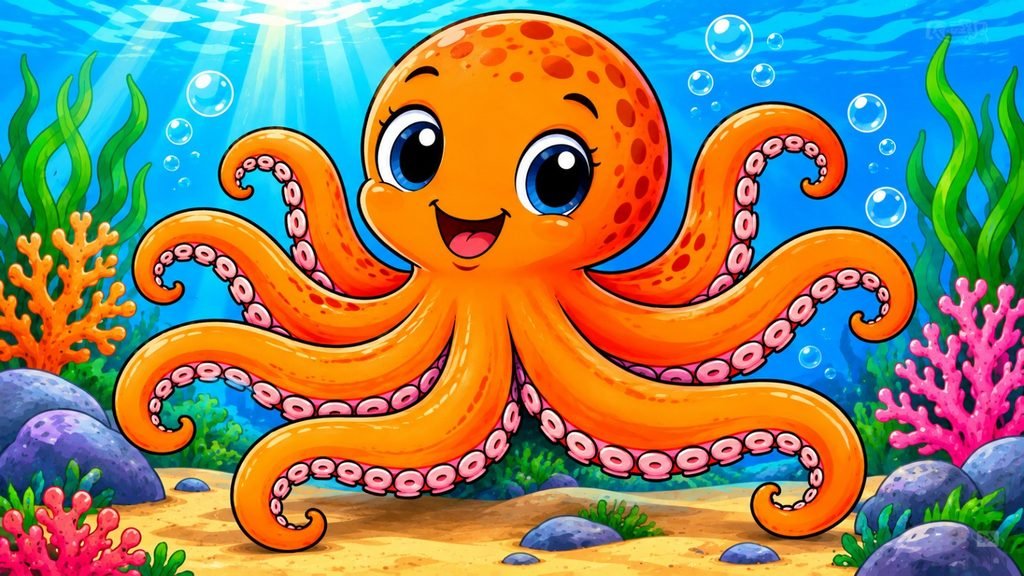
Step 1: Draw the Head
Start by drawing a large oval or rounded dome near the upper-middle part of your paper. This shape will become the mantle.
Keep your pencil strokes light because you may need to adjust the shape later. Avoid making the head too small because you need enough space for the eyes and facial details.
Step 2: Add the Lower Body Outline
Create a gentle curved line beneath the head to establish where the arms will begin. This helps connect the body with the tentacles.
Step 3: Sketch the First Two Arms
Draw one curved arm extending toward the left and another toward the right. Use flowing lines rather than sharp angles.
Allow the ends to curl slightly. This creates a natural underwater appearance.
Step 4: Draw Two More Arms
Add two arms beneath the first pair. One can curve downward, while the other can move outward.
Do not make every arm exactly the same length. Different shapes will make your octopus drawing more interesting.
Step 5: Complete All Eight Arms
Continue adding the remaining arms until you have eight. Some arms can overlap or disappear behind the front arms.
Remember that the arms should become narrower toward their tips. This small detail makes the drawing look more natural.
Step 6: Add the Eyes
Draw two round eyes on the front of the head. For a cartoon style, make them relatively large.
Add smaller circles inside the eyes for pupils. Leave tiny white areas to create attractive highlights.
Step 7: Draw a Friendly Smile
Add a small curved mouth beneath the eyes. You can also include cheeks, eyebrows, or a tiny tongue if you want a playful character.
Step 8: Add Suction Cups
Draw small circles or oval shapes along the undersides of the arms. These represent the suction cups that octopuses use to grip surfaces and interact with their surroundings.
You do not need to draw every individual sucker in a beginner sketch. A few carefully spaced circles can create the desired effect.
Step 9: Refine the Outline
Review the head, arms, eyes, and mouth. Remove unnecessary guidelines and improve any uneven curves.
Step 10: Add Color
Choose your favorite colors and fill the different sections. Pink, purple, orange, and blue are popular choices for cartoon artwork.
Your first octopus drawing is now complete. You can add bubbles, seaweed, coral, or a sandy ocean floor to create a complete underwater scene.
5. Easy Octopus Drawing for Beginners
An easy octopus drawing is an excellent starting point for people who have little or no drawing experience.
The trick is to divide the subject into simple shapes rather than trying to draw everything at once.
Begin with a large oval for the head. Add two eyes and a smile. Next, draw eight curved lines around the lower body and gradually turn those lines into wider arms.
For your first attempt, you can simplify the suction cups into small dots. You can also leave out complicated skin patterns and shadows.
Beginner Drawing Tips
- Use a light pencil.
- Start with the head before drawing the arms.
- Practice curved lines separately.
- Keep the arms different in length.
- Avoid adding too many small details.
- Color the finished artwork slowly.
The goal is not to create a perfect illustration immediately. Practice helps you understand proportions and improve your control over the pencil.
6. Cute Octopus Drawing for Kids
A cute octopus drawing is particularly popular among young children because it combines simple shapes with a friendly expression.
To create this style, draw a large rounded head, two oversized eyes, and a smiling mouth. Make the arms soft and curly rather than sharp or complicated.
You can add pink cheeks, small eyebrows, and colorful spots to give your character more personality.
Ideas for a Cute Character
- A smiling pink octopus
- A purple octopus wearing a small crown
- A baby octopus surrounded by bubbles
- A happy octopus holding a heart
- A cartoon octopus wearing a tiny hat
Children can choose their own color combinations. There is no requirement to use realistic ocean colors in a playful illustration.
This activity is also useful for classroom art sessions, weekend projects, and rainy-day activities.
7. Simple Cartoon Octopus Drawing
A cartoon octopus drawing focuses on personality instead of complicated anatomical details.
The head is usually larger than the arms, while the eyes are exaggerated to make the character expressive.
Start with a rounded head and sketch eight short or medium-length arms around it. Make some arms curl inward and others curl outward.
Add a cheerful face, bold outlines, and a few decorative details.
Cartoon Style Suggestions
Happy octopus: Use a wide smile and bright eyes.
Sleepy octopus: Draw closed eyes and a relaxed mouth.
Surprised octopus: Create larger eyes and a small open mouth.
Funny octopus: Give the character different arm positions and a playful expression.
Cartoon illustrations are especially useful for children’s books, stickers, greeting cards, and personal art projects.
8. Realistic Octopus Drawing
A realistic octopus drawing requires more attention to body structure, light, shadow, and texture.
Unlike cartoon artwork, realistic illustrations should show the natural appearance of the animal.
Start with a slightly irregular rounded mantle instead of a perfect circle. Add the eyes carefully and sketch the arms in different directions.
Pay particular attention to the thickness of each arm. The arms should generally be wider near their attachment point and narrower toward their tips.
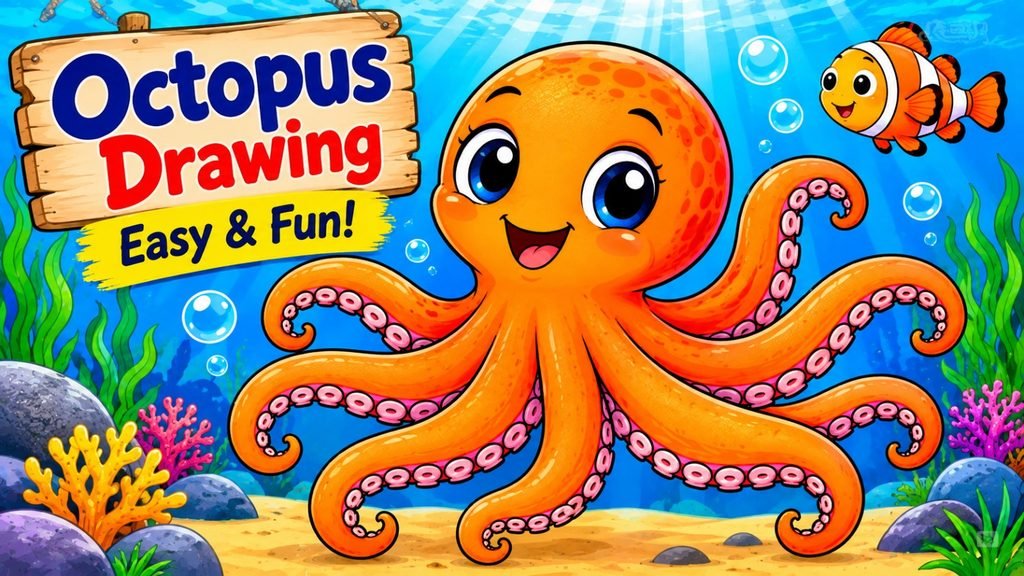
Adding Realistic Details
Include small wrinkles and subtle skin patterns across the mantle. Draw rows of suction cups along the inner surfaces of the arms.
Use light shading to show the rounded shape of the body. Darker areas can appear beneath overlapping arms and around recessed details.
Avoid using equally dark lines everywhere. Variation in line weight helps separate the different parts of the animal.
A realistic octopus drawing may take longer than a cartoon illustration, but the additional details can produce an impressive result.
9. Octopus Pencil Drawing
A pencil octopus drawing is a good option for artists who enjoy traditional sketching.
It does not require colored materials, and you can create a beautiful illustration using only a pencil, paper, and eraser.
Start with light construction lines. Establish the mantle, eyes, and approximate position of the eight arms.
Once the overall shape looks balanced, refine the outlines and begin adding details.
Pencil Shading Techniques
Light shading: Use gentle pencil strokes to establish the basic body shape.
Dark shading: Add darker areas beneath the mantle and between overlapping arms.
Cross-hatching: Use intersecting lines to create texture and darker values.
Blending: Smooth selected graphite areas with a blending stump or suitable paper tool.
Highlights: Preserve small areas of white paper to represent reflected light.
A pencil sketch can be simple or highly detailed depending on your experience.
10. Octopus Drawing with Color
Adding color can completely change the appearance of an illustration.
You can choose a realistic color palette or create an imaginative character using bright shades.
Popular Color Combinations
| Main color | Additional colors |
|---|---|
| Purple | Pink and lavender |
| Orange | Yellow and red |
| Pink | White and light purple |
| Blue | Turquoise and navy |
| Red | Orange and dark red |
| Green | Yellow and teal |
For a cartoon octopus, use bright colors and clean outlines. For a realistic artwork, observe reference photographs and use several shades rather than one flat color.
Colored pencils are useful for smooth blending, while markers provide stronger and more consistent color.
11. How to Draw Eight Octopus Arms
The eight arms are one of the most recognizable features of an octopus.
Many beginners find this part difficult because they accidentally draw all the arms in a straight line.
The solution is to plan the position of each arm before completing its outline.
First, draw eight light guide lines extending from the central body. Give each line a different direction.
For example:
- Two arms can curl toward the left.
- Two arms can extend toward the right.
- Two arms can curve downward.
- Two arms can bend toward the front.
These are only suggested positions. You can change them to create a different pose.
Once the guide lines are ready, draw two smooth boundaries around each line to create the actual arm.
Remember that arms can overlap. Use this feature to create depth and movement in your octopus drawing.
12. How to Draw Octopus Suction Cups
Suction cups are small rounded structures found along the undersides of an octopus’s arms.
They are important details because they help make the animal recognizable.
For a simple drawing, use small circles placed at regular intervals along the inner surface of each arm.
For a more realistic illustration, draw oval shapes that follow the direction and curve of the arm.
The circles should not all have exactly the same size. Their appearance changes according to perspective and position.
You can also add a little shading around each sucker to make it look raised.
13. Different Octopus Drawing Styles
One of the biggest advantages of this subject is its flexibility. You can experiment with different art styles without changing the basic animal structure.
Minimalist Octopus Drawing
Use a few smooth lines to create a recognizable octopus. Avoid unnecessary patterns and background details.
Anime-Inspired Octopus Drawing
Give your character expressive eyes, colorful highlights, and exaggerated facial features.
Realistic Marine Illustration
Focus on anatomy, detailed suction cups, skin texture, and natural shadows.
Cute Chibi Octopus
Create a very large head, tiny facial features, and short rounded arms.
Doodle Octopus
Use loose, playful lines and decorative patterns. This style is suitable for notebooks and creative journals.
Black and White Octopus Drawing
Use graphite or ink to focus on outlines, texture, and contrast without relying on color.
14. Easy Octopus Drawing Ideas
If you want to try something different, consider these creative ideas:
- A smiling octopus with large eyes.
- A baby octopus with short arms.
- A purple octopus underwater.
- A realistic octopus pencil sketch.
- An octopus surrounded by colorful bubbles.
- A cartoon octopus holding a heart.
- An octopus sitting on a rock.
- An octopus hiding inside a shell.
- An octopus with a small crown.
- A sleeping octopus with closed eyes.
- An octopus swimming above coral.
- An octopus with patterned arms.
- A black-and-white octopus outline.
- An octopus wearing glasses.
- An octopus in a magical underwater kingdom.
These ideas can help you develop new characters and experiment with different compositions.
15. Octopus Drawing for Preschoolers
Young children can enjoy drawing even when they are still developing their pencil control.
For preschoolers, keep the activity short and use simple shapes.
An adult can lightly draw a large oval as a starting point. Children can then add eyes, a mouth, and simple curved arms.
Instead of expecting perfect proportions, encourage children to explore different shapes and colors.
A Simple Preschool Activity
- Give the child a sheet of paper.
- Help them draw a large oval.
- Add two large eyes.
- Draw eight simple curved arms.
- Add small dots for suction cups.
- Let the child color the character.
Parents can ask questions about the animal while drawing, such as how many arms it has and where it lives.
This makes the activity both creative and educational.
16. Octopus Drawing for School Projects
An octopus illustration can be useful for school assignments about marine life, ocean habitats, and sea animals.
Students can create a labeled diagram showing the mantle, eyes, arms, and suction cups.
A colorful underwater background can make the project more attractive.
You can also write a few simple facts beside the artwork:
- An octopus is a marine invertebrate.
- It belongs to the cephalopod group.
- It has eight arms.
- Its arms contain suction cups.
- Many octopus species can change their color and skin appearance.
Make sure the labels are readable and the drawing has enough space around it.
17. Common Mistakes to Avoid
Even a simple drawing can become difficult when basic proportions are ignored.
Here are some common problems and ways to correct them.
Drawing Only Six Arms
An octopus has eight arms. Some may be hidden behind the body or overlap in a particular pose, but your planned drawing should account for all eight.
Making Every Arm Straight
Octopus arms are flexible. Use different curves and curls to create a more natural appearance.
Drawing Arms with Equal Thickness
Make the arms wider near the body and gradually narrower toward the tips.
Adding Too Many Details Too Early
Complete the basic outline before adding suction cups, spots, and shadows.
Using Too Much Pressure
Heavy pencil strokes are difficult to erase. Begin lightly and darken the final lines later.
Ignoring the Background
A simple underwater setting can improve the overall composition. However, do not add so many decorations that the octopus becomes difficult to see.
18. Shading and Texture Techniques
Shading adds depth to an illustration and helps distinguish the head from the arms.
First, imagine where the light is coming from. If the light source is above the octopus, the upper part of the mantle may be brighter while the lower sections receive more shadow.
Use light graphite strokes to establish the rounded shape.
Add darker values underneath overlapping arms. This makes the front arms appear closer to the viewer.
For texture, use small curved marks, dots, and irregular patterns. Avoid covering the entire body with identical marks.
A realistic octopus drawing benefits from a combination of smooth shading and carefully placed details.
19. Creative Underwater Background Ideas
An underwater background can turn an ordinary drawing into a complete marine illustration.
You can add:
- Colorful coral reefs
- Green seaweed
- Small ocean fish
- Floating bubbles
- Sandy ocean floors
- Underwater rocks
- Seashells
- Sunlight rays
- Water plants
For a children’s drawing, keep the background colorful and simple.
For a realistic illustration, use softer colors and atmospheric shading. The octopus should remain the main subject.
20. Digital Octopus Drawing
Digital art provides another way to create an octopus illustration.
You can use a tablet, stylus, or computer drawing application to create outlines, colors, and textures.
Begin with a basic sketch layer. Add a separate layer for the clean outline and another layer for color.
Use different brushes for different effects. A smooth brush is suitable for the main body, while textured brushes can help create realistic skin details.
One advantage of digital drawing is that you can experiment without damaging your original sketch. Layers also make it easier to adjust individual arms or change the color palette.
21. How to Improve Your Octopus Drawing Skills
Drawing improves through regular practice rather than one perfect attempt.
Start by creating several small sketches instead of spending all your time on one complicated illustration.
Practice the following exercises:
Curved lines: Draw different S-shaped and U-shaped curves.
Basic shapes: Practice ovals, circles, and rounded forms.
Arm positions: Sketch tentacles in different directions.
Suction cups: Draw small circles and ovals in organized rows.
Shading: Practice making smooth transitions from light to dark.
Color combinations: Experiment with different shades of purple, blue, pink, and orange.
You can also observe photographs of real octopuses to understand how their bodies and arms move.
Keep your earlier drawings so you can compare your progress over time.
22. Benefits of Drawing for Children
Drawing is more than an entertaining activity. It can support several useful learning experiences.
Improves Hand-Eye Coordination
Following curved lines and adding small details encourages children to coordinate what they see with how they move their hands.
Encourages Creativity
Children can invent characters, choose colors, and create their own underwater scenes.
Develops Patience
Completing an illustration one step at a time teaches children to work through a process.
Supports Observation
Drawing ocean animals encourages children to notice shapes, patterns, and differences between creatures.
Builds Confidence
Finishing a drawing gives children an opportunity to appreciate their own effort.
These benefits are not limited to octopuses. Similar activities can be explored with fish, turtles, dolphins, crabs, and other marine animals.
23. How to Make Your Octopus Drawing Look More Attractive
Small improvements can make a big difference.
Start by checking the overall balance of the composition. Make sure the head is large enough and the arms have enough space to spread out.
Use a combination of long and short curves. Avoid placing every arm at the same angle.
Add a few highlights to the eyes and use darker outlines around important features.
Choose a background that supports the main character instead of distracting from it.
Finally, leave some clean space around the illustration. A drawing does not need to fill every part of the paper.
24. Best Ways to Use Your Finished Artwork
Once you have completed your illustration, you can use it in several creative ways.
- Decorate a school notebook.
- Create a handmade birthday card.
- Make a marine-life poster.
- Design a children’s coloring page.
- Decorate a bedroom or classroom.
- Add it to an art portfolio.
- Create a digital sticker.
- Make an underwater-themed greeting card.
You can also photograph your finished artwork and keep it in a personal collection.
25. Frequently Asked Questions About Octopus Drawing
1. How do you draw an octopus easily?
Start with a large oval for the mantle. Add two eyes, a small mouth, and eight curved arms. Finish by adding simple suction cups and your favorite colors.
2. Is octopus drawing suitable for beginners?
Yes. Beginners can use basic shapes and simple curved lines. You do not need advanced drawing skills to create an attractive octopus illustration.
3. How many arms should an octopus drawing have?
A typical octopus has eight arms. Some arms may be hidden behind others depending on the viewing angle.
4. What materials are best for octopus drawing?
A pencil, paper, eraser, and coloring pencils are enough for a basic drawing. Markers and watercolor paints are optional.
5. How do you draw a cute octopus?
Draw a large rounded head, oversized eyes, a friendly smile, and eight soft curved arms. Add cheeks and bright colors to create a cute character.
6. How do you draw a realistic octopus?
Study the body structure, sketch the mantle, plan eight flexible arms, and add detailed suction cups. Use shading and texture to create a realistic appearance.
7. What colors should I use for an octopus?
Purple, pink, orange, red, and blue are popular artistic choices. You can also study photographs to choose colors inspired by real species.
8. How do you draw octopus tentacles?
Begin with curved guide lines. Draw two boundaries around each guide, making the arm wider near the body and thinner toward its tip.
9. How do you add suction cups to an octopus drawing?
Draw small circles or oval shapes along the undersides of the arms. Follow the natural curve and leave enough space between the shapes.
10. Can kids create an octopus drawing?
Yes. Children can use basic shapes, simple outlines, and bright crayons. Parents and teachers can make the activity easier by dividing it into small steps.
11. How long does an octopus drawing take?
A simple cartoon version may take around 10 to 20 minutes. A detailed pencil illustration can require considerably more time depending on the level of detail.
12. Can I draw an octopus without coloring it?
Yes. A black-and-white pencil sketch or ink outline can look attractive without any additional color.
13. What is the easiest octopus drawing style?
A simple cartoon style is often easiest because it uses a rounded head, basic facial features, and uncomplicated curved arms.
14. How can I make my octopus drawing look three-dimensional?
Use light and dark shading, vary the thickness of the outlines, and add shadows where the arms overlap.
15. Where can I find inspiration for octopus drawing ideas?
You can observe marine-life photographs, art tutorials, children’s drawing books, and underwater illustrations. Studying different examples can help you develop your own style.
Conclusion
Learning an octopus drawing is a fun way to explore creativity, improve drawing skills, and discover more about marine life. From simple cartoon characters to realistic pencil illustrations, there are many styles to experiment with.
The easiest approach is to begin with basic shapes, plan all eight arms, add facial features, and gradually include suction cups and texture. Once the outline is complete, you can experiment with different colors and underwater backgrounds.
Whether you are drawing for school, practicing at home, or creating artwork as a hobby, remember that every attempt is an opportunity to improve. Start with simple ideas, practice regularly, and allow your imagination to guide your next octopus drawing.
Your artwork does not need to look exactly like someone else’s. The most enjoyable part of drawing is creating something that reflects your own creativity.


